AI-Era API Protection: Mobile App Shielding, Hardware Attestation, and Policy-Checked Routing
The mobile trust problem is getting harder
Mobile apps have always operated outside the clean perimeter that security teams wish they had. They run on devices the app owner does not control, across networks the app owner does not operate, beside other apps the app owner cannot audit. For financial services, healthcare, insurance, retail, government, and identity apps, that creates a difficult question: how much should the backend trust a request that appears to come from the mobile app?
AI raises the stakes.
Modern AI-assisted tooling can help attackers explain decompiled code, generate Frida hooks, map API endpoints, summarize traffic flows, write replay scripts, and iterate through bypass ideas faster than before. A mobile app that once required specialist reverse-engineering skill can now be analyzed by a much wider group of attackers using decompilers, emulators, proxy tools, and AI assistants.
That does not make mobile app shielding obsolete. It makes it more important.
The security goal can no longer be limited to hiding code or slowing down static analysis. Modern mobile defense has to answer two deeper questions in real time:
- Is this app running in an environment that should be allowed to handle sensitive user activity?
- Should this device and app instance be allowed to reach protected backend APIs?
Runtime app shielding, hardware attestation, and policy-checked API routing are complementary answers to those questions. Together, they help turn mobile trust from an assumption into something that must be evaluated repeatedly.
Shielding still protects real people, not just code
It is easy to describe app shielding as anti-reverse-engineering technology. That is true, but incomplete. For many mobile teams, the more urgent value is user protection.
Imagine a banking customer whose phone has a malicious accessibility service, spyware, a screen overlay, a debugging tool, or a modified OS image. The customer may not know anything is wrong. They open the legitimate banking app, check a balance, approve a transfer, or upload identity documents. To the user, the session looks normal. To the backend, the request may also look normal: correct credentials, expected device metadata, familiar IP range, valid session token.
The risk is happening inside the device environment, where ordinary backend controls have very limited visibility.
Runtime shielding gives the app a way to defend itself while it is running. It can inspect the local environment, detect suspicious runtime conditions, and respond before sensitive workflows continue. Those responses might include blocking the session, hiding sensitive UI, preventing screenshots or screen recording, protecting clipboard data, terminating the app, showing a clear branded warning, or sending security telemetry for investigation.
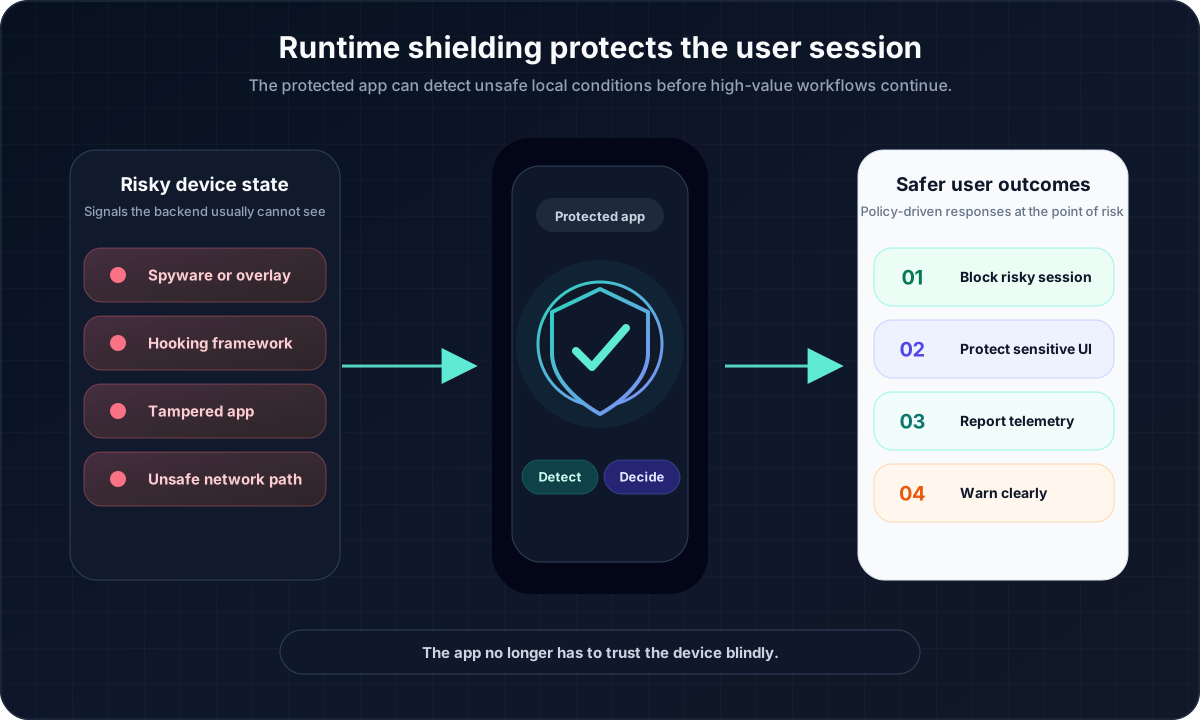
This matters most when users cannot reliably protect themselves. A user may not recognize spyware. They may not understand why a rooted device weakens security boundaries. They may not notice an overlay attack designed to steal credentials. In those moments, the protected app is one of the few controls that can still see the local runtime and make a decision at the point of risk.
App shielding does not promise to clean malware from a device. That is not the point. Its job is narrower and more practical: reduce what attackers can observe, detect active manipulation, limit sensitive data exposure, and keep high-risk sessions from proceeding silently.
For banking, fintech, brokerage, lending, payments, crypto, insurance, and digital wallet apps, that distinction is critical. The question is not whether every compromised device can be repaired. The question is whether the app should continue handling high-value activity when the runtime shows signs of compromise.
AI also makes backend abuse easier
The backend is often the larger target.
Once attackers understand how a mobile app communicates with its server, they can try to bypass the app entirely. They can generate scripts that mimic legitimate clients, replay captured requests, enumerate endpoints, automate credential stuffing, scrape data, or test business-logic abuse at scale. AI compresses the time required to move from app analysis to working automation.
Traditional mobile API defenses still matter, but each has limits:
- API keys embedded in a mobile binary can be extracted.
- Obfuscated endpoint strings can eventually be recovered.
- Certificate pinning reduces network interception, but it does not prove the caller is a genuine protected app on a trustworthy device.
- User authentication proves something about the user, but not necessarily about the device or app runtime.
- Rate limiting slows abuse, but cannot reliably distinguish a real protected app from a scripted client with valid credentials.
The stronger pattern is to make sensitive backend access conditional on mobile integrity signals. In other words, the backend should not only ask, "Is this user authenticated?" It should also ask, "Did this app instance recently produce signals that match policy?"
That is the shift hardware attestation enables.
Hardware attestation moves trust out of the app
Mobile apps are not ideal places to store permanent trust. They can be decompiled, instrumented, repackaged, proxied, and run in environments the app owner never intended. Hardware-backed attestation improves the model by asking the platform to produce a verifiable statement about the app and device.
On Android, that usually means Play Integrity. On iOS, it means App Attest and related platform capabilities. The exact signals vary by platform and configuration, but the model is the same: the app requests a fresh challenge, the platform produces a signed attestation response, and the server verifies that response before granting access.
A well-designed attestation flow can help establish that:
- The proof is fresh and tied to a server-provided nonce.
- The app identity matches the expected package or bundle.
- The device environment meets the required platform integrity threshold.
- Replay attempts can be rejected.
- Backend tokens are issued only after server-side verification.
That last point is the architectural shift. Instead of trusting a static secret embedded in the app, the backend can issue short-lived tokens only after recent device verification.
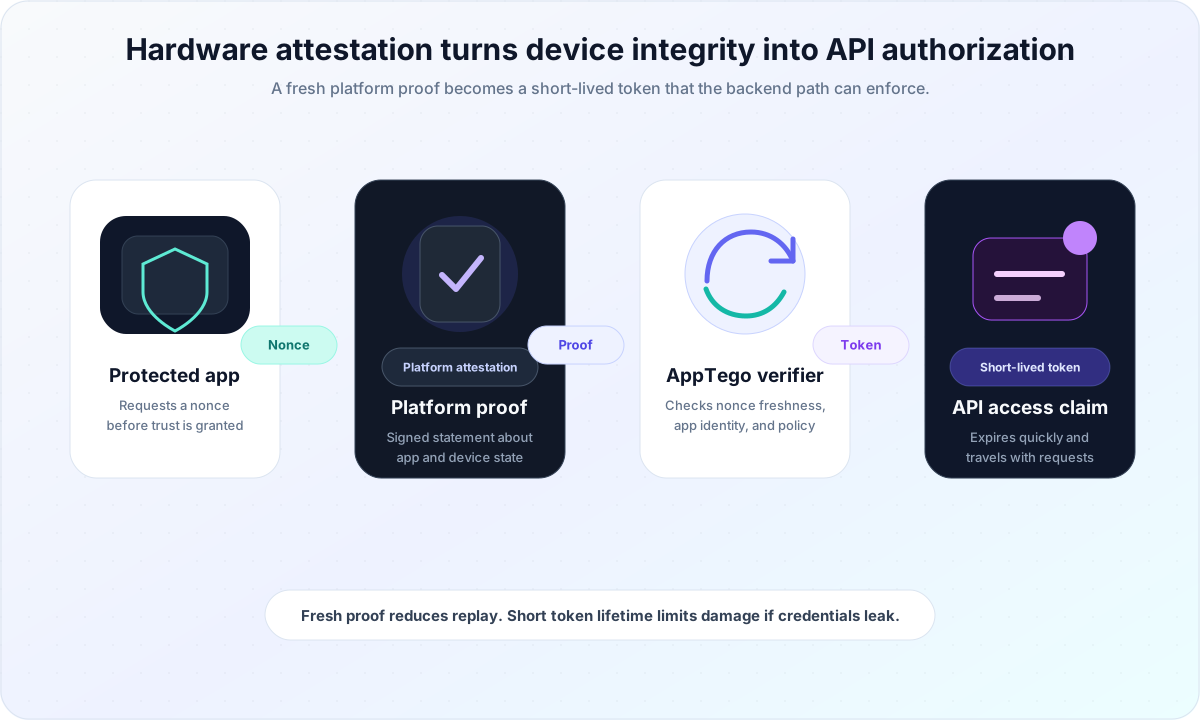
Hardware attestation is not a replacement for user authentication, fraud monitoring, secure backend design, or runtime shielding. It is a trust input. Its value is highest when it is tied to backend authorization decisions and token issuance. A valid username and password should not automatically mean a high-risk device can reach every sensitive API. A recently attested app instance gives the backend a stronger basis for access.
For high-risk workflows, this should become part of the API security boundary.
Policy-checked routing narrows the gap between app and API
Attestation becomes even more powerful when it controls the network path to the backend.
AppTego extends mobile shielding with an API protection model built around Shield Proxy: an attestation-informed proxy path for selected mobile app traffic. Customer backends can be configured to prefer or require traffic from AppTego proxy egress paths. Mobile apps protected by AppTego route selected API traffic through Shield Proxy. Shield Proxy checks that each request carries a fresh token issued after attestation before forwarding traffic to the customer backend.
<figure class="media-frame light blog-video-frame"> <video controls muted autoplay loop playsinline preload="auto" poster="/assets/img/resources/shield-proxy-verified-tunnel.svg" aria-label="Shield Proxy policy-checked API traffic demo"> <source src="/assets/img/resources/website-demo-shield-proxy.mp4" type="video/mp4"> </video> <figcaption class="media-caption"><strong>Shield Proxy demo</strong><span>See app traffic routed through a policy-checked API path.</span></figcaption> </figure>
At a high level, the flow works like this:
- The protected app requests a nonce from AppTego.
- The device performs hardware attestation with Play Integrity or App Attest where configured.
- AppTego evaluates the attestation server-side.
- AppTego issues a short-lived proxy session token for that device, tenant, and attestation method.
- The protected app attaches that token to proxied API requests.
- Shield Proxy checks the token, checks tenant policy, applies routing and rate-limit rules, and forwards approved traffic.
- The customer backend can be configured to accept sensitive mobile API traffic from AppTego proxy egress paths.
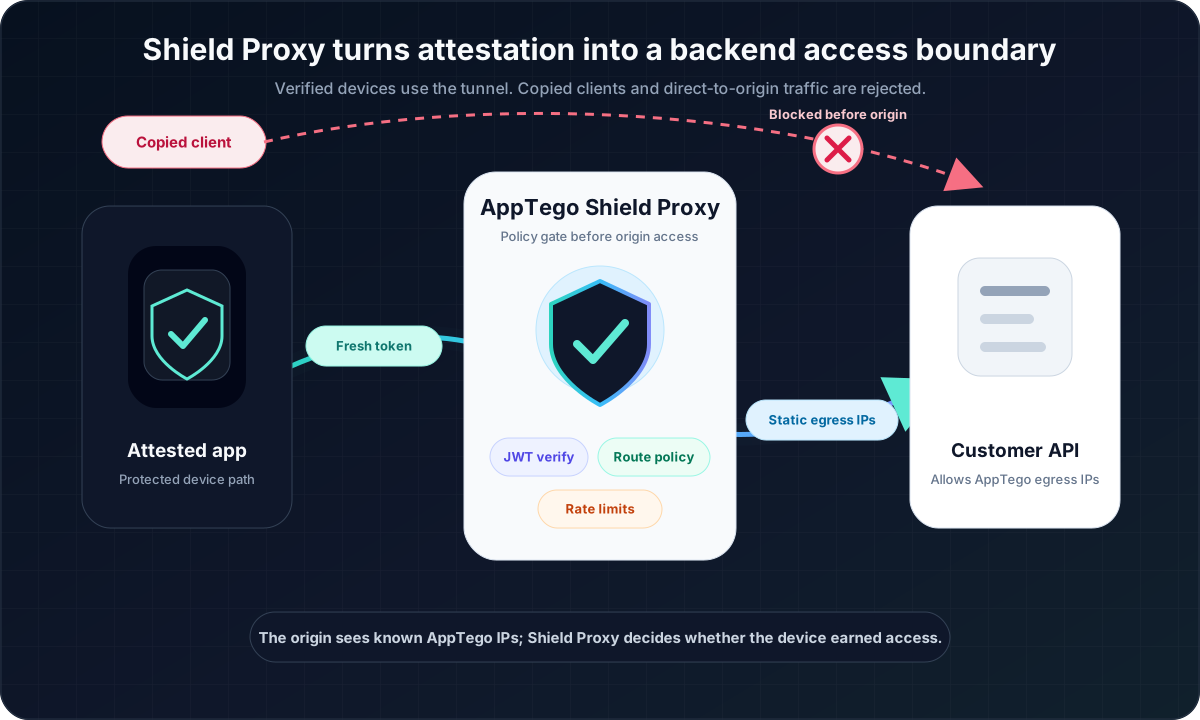
This does not mean the proxy replaces the customer's authentication or authorization logic. The backend still authenticates users, enforces business rules, checks permissions, and protects data. Shield Proxy adds a separate question at the network boundary: did this request arrive through a recently verified protected app path?
That is a powerful distinction. If an attacker reverse engineers the app and writes a copied client, endpoint knowledge alone is no longer enough. The copied client also needs a fresh attestation-backed proxy token, valid tenant policy, acceptable attestation method, and access through the allowlisted proxy path.
When selected requests flow through a controlled point, Shield Proxy also becomes a natural place to apply policy that is awkward or expensive to implement inside the app or behind the origin:
- Per-device rate limiting. Throttle by attested device identity, not just IP or user, so a single compromised handset cannot drive abuse at scale even with valid credentials.
- WAF rules. Apply request inspection, signature matching, and anomaly rules at the edge before traffic ever reaches the customer origin.
- Domain and path allowlisting. Restrict each tenant to a defined set of upstream hosts and API paths, so a leaked token cannot be repurposed against unrelated endpoints or unintended environments.
- Tenant-scoped policy. Tune attestation strictness, fail-open versus fail-closed behavior, and routing per tenant or per endpoint without redeploying the mobile app.
The result is not invincibility. No serious security architecture should promise that. The result is layered friction that directly targets the AI-era attack pattern: quickly learn the app, copy the API behavior, and automate abuse outside the protected runtime.
Short-lived tokens keep the trust window narrow
The proxy token should not become a new long-lived bearer secret. If a token is valuable enough to unlock backend access, it must expire quickly and be cheap to rotate.
In the Shield Proxy design, the attestation flow issues a short-lived session token, such as a 15-minute JWT. The token can include claims such as device ID, tenant ID, issue time, expiry, attestation method, and a unique token ID. Shield Proxy can verify that token locally using an HMAC signing secret, which keeps per-request latency low and avoids database lookups on every API call.
Short lifetime matters for two reasons:
- It reduces the useful life of a stolen token.
- It allows tenant policy changes, revocation, and attestation tolerance rules to take effect quickly.
For usability, token refresh should not require full hardware attestation every few minutes. A lighter refresh path can issue new short-lived session tokens while periodically falling back to full attestation when needed. That keeps normal app use smooth while preserving a narrow trust window for backend access.
The key principle is simple: API access should be time-bound, device-bound, and policy-bound. A copied endpoint is not enough. A replayed request shape is not enough. A script with valid user credentials is not necessarily enough. Sensitive APIs should require proof that the caller recently passed the mobile integrity checks expected by the business.
What this means for banking and fintech apps
Financial apps sit at the intersection of user safety and backend abuse. A compromised device can expose credentials, observe balances, intercept one-time codes, manipulate UI, or automate transactions from inside a real user session. A reverse-engineered API can enable fraud at scale even without controlling a real user's phone.
The strongest architecture protects the full path:
- Inside the app: Runtime shielding detects tampering, instrumentation, overlays, unsafe device state, screen exposure, and suspicious network conditions.
- At attestation time: Hardware-backed proof adds app and device signals before sensitive access tokens are issued.
- On proxied requests: Short-lived proxy tokens indicate that the request came from a recently evaluated app instance.
- At the network boundary: Customer backends can be configured to prefer or require sensitive mobile API traffic from known proxy egress paths.
- In policy: Teams can decide whether to require hardware attestation only, allow proof-of-work fallback for broader compatibility, fail closed during outages, and tune rate limits by tenant or endpoint.
This model is especially relevant for account access, transfers, payment initiation, card provisioning, loan applications, identity verification, brokerage trading, claims submission, and wallet transactions. These workflows should not depend only on the hope that the mobile app has not been copied or that the user's device is healthy.
User protection and API protection reinforce each other
Mobile security is sometimes split into two separate conversations: protect the app user, or protect the backend. In practice, those goals reinforce each other.
When the app detects a compromised runtime, it can protect the user by blocking sensitive screens, warning clearly, terminating risky sessions, or preventing data exposure. When the backend requires attestation-backed proxy tokens, it protects the service from clients that never passed through the protected app path.
The trust model becomes healthier:
- The app does not blindly trust the device.
- The backend does not blindly trust the app.
- The proxy does not blindly trust the network request.
- The user is not left alone to recognize device compromise.
This is the direction mobile security has to move. AI makes app analysis and API automation easier. Defenses need to bind together what attackers prefer to separate: the app binary, the runtime environment, the device identity, the token lifecycle, and the backend network boundary.
Practical guidance for mobile teams
Harden the runtime. Prioritize root and jailbreak detection, app tampering, debugger and hooking detection, overlay protection, screen security, clipboard protection, and certificate pinning. Tune responses carefully — some threats should terminate the app immediately, while others may be better handled with a branded warning, support link, or logged event during an observation period.
Replace static app secrets with attestation-gated sessions. Require fresh nonces, verify platform attestations server-side, keep tokens short-lived, and avoid treating a logged-in user session as proof of device integrity.
Put high-risk APIs behind a policy-checked proxy path. If the origin is configured to prefer or require traffic from a trusted proxy, and that proxy forwards requests from recently evaluated app instances, reverse engineering the endpoint becomes less useful.
Roll out by risk, not by endpoint count. Start with your highest-value workflows rather than trying to protect every endpoint on day one. Observe threat telemetry, tune policy in staging, decide where fail-closed behavior is appropriate, and document what happens when attestation is unavailable or a device falls back to a lower-trust method.
The future of mobile trust is verified
The AI era does not remove the need for mobile app shielding. It widens the gap between teams that rely on static assumptions and teams that continuously evaluate trust.
Attackers can learn faster, automate more, and scale abuse with less expertise. Mobile defenses have to respond by making trust more explicit at every layer: protect the app at runtime, use hardware attestation signals, issue short-lived tokens, route sensitive APIs through a controlled path, and enforce backend access based on evaluated integrity.
That is how mobile apps can continue protecting users even when devices are risky, networks are hostile, and attackers have better tools than ever.
AppTego's codeless shielding already helps teams add runtime protection without changing application source code. With Shield Proxy and hardware attestation signals, that trust model can extend beyond the app and into the backend path, helping sensitive APIs favor recently evaluated app sessions over copied clients.
Ready to see this in your own stack? Talk to the AppTego team about a Shield Proxy walkthrough, attestation policy review, or a protected build of your Android or iOS app — no source code changes required.